Essay I
Energy Twilight: Europe, Laboratory of the World to Come?
By Charles Peloye
First published in French by Antithèse on July 17, 2026 · 6 min read
Translated from the French.
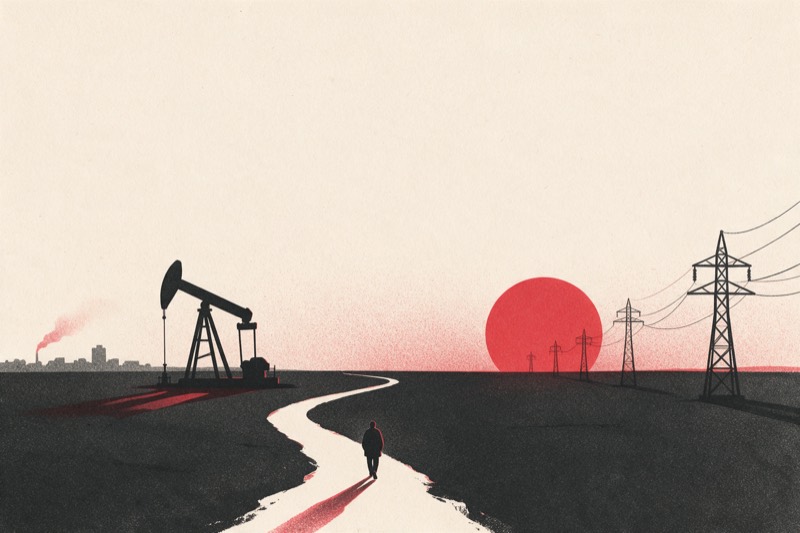
In an age of material contraction, the question of whether capitalism can endure is no longer only an ideological one: it runs up against a set of physical limits. As cheap resources grow scarce, the balance of power shifts and the maps are redrawn. Shaken by the emergence of this new world order, the liberal democracies are sliding, little by little, into authoritarianism, even into something close to fascism. Old Europe is not immune to this drift, but it has intellectual and cultural resources that could allow it to imagine the future differently.
This is no longer a fringe view. The International Energy Agency itself has acknowledged it: world production of conventional crude oil — the “easy” oil drawn from ordinary fields, the oil that has fed growth since the dawn of the industrial age — peaked in 2008 (Institut des actuaires, in French). The unconventional alternatives (shale oil, tar sands, deep offshore) cost more to extract, in capital as in energy: the energy return on investment of hydrocarbons — EROI, the ratio of energy produced to energy invested — has been falling steadily for decades. The energy transition, a dominant idea born of a “phasist” account of energy history, does not seem equal to the problem. This is the argument the historian Jean-Baptiste Fressoz makes in More and More and More: An All-Consuming History of Energy (2024): “The total weight of the materials used by the economy has been multiplied by twelve, and after the year 2000 we saw a new acceleration, far stronger than the famous ‘great acceleration’ of the 1950s. Until now, then, processes of substitution have always been offset by the expansion of markets, by rebound effects and by shifts in use.” Energy sources have so far lived in symbiosis, piling up on top of one another far more than they have replaced one another.
The point, then, is not to predict that the tank is about to run dry, but to recognize a deep trend: abundant, cheap energy, the unspoken condition of capitalism’s development, belongs to the past.
The Illusion of Shared Prosperity
For decades, the implicit promise of globalized capitalism rested on a horizon of catching up: the countries of the Global South were, in time, to reach the Western standard of living. The wider West (North America, the European Union, Japan and Oceania) accounts for barely more than 12 percent of the world’s population. To universalize its way of life, and the energy needs inseparable from it, would require resources the planet can no longer supply at the pace demanded. The development of the South and its new alliances therefore confront the West with an uncomfortable dilemma: accept the gradual decline of its populations and its economy, or protect its predatory metabolism by force.
America’s Survival Operations
The war waged on Iran, the military campaign against Venezuela, the country with the largest oil reserves in the world, and the openly declared designs on Greenland and Canada are telling in this respect. A dominant nation, aware of its dependencies and of the end of its hegemony, seems ready for any compromise and any authoritarian measure in its attempt to preserve its wealth and its supplies.
At home, the mechanism is just as legible. Unable to buy social peace with growth, that is, with a steadily rising standard of living, Western governments buy it with division. Designating scapegoats (the immigrant, the unemployed, the minority) diverts minds from material frustration; the polarization of public debate prevents the working and middle classes from forming a common front; the manufacture of foreign enemies justifies a permanent state of emergency and the sacrifices demanded in the name of “national security.”
Europe in a Vise
In this world being remade, Europe finds itself in a structural position even more precarious than that of the United States. With no fossil resources of its own, it struggles to secure its supplies and is penalized on every front. The wave of sanctions that followed Russia’s invasion of Ukraine, then the sabotage of Nord Stream in 2022, hastened the break; the fact remains that Europe alone is paying the energy and economic bill. Deprived of the cheap Russian gas and oil on which much of its competitiveness rested, it has become more dependent on American liquefied natural gas (LNG), far more expensive for structural and political reasons, which speeds up a deindustrialization already well under way. The solution some propose, restoring Russian gas and oil supplies by resuming diplomatic and trade relations, would not settle the underlying questions and would amount to short-term thinking.
Nor has Europe ever managed to develop a doctrine of economic warfare to defend its interests, as many of its competitors have done. The latest evidence is its role as a mere extra in the race for artificial intelligence. Geopolitically, it clings to an unstable diplomatic posture, its outlines ever harder to read, whose main effect is to deepen its dependencies and hand its attractive consumer market over to the grip of foreign powers.
A Laboratory by Necessity?
Must we conclude that Europe is doomed to fade away slowly, or to join the camp of brutality in its turn? That would be to forget the dialectic of its history. It is precisely its material vulnerability that makes Europe a laboratory, by necessity, of the world to come. Although the political sphere advances into the twenty-first century armed with obsolete dogmas and mechanisms, many researchers and engaged citizens are already working to shape a realistic future.
The model that some would defend by force is itself showing signs of exhaustion, even in its strongholds. In 2025, France’s agricultural trade balance went into the red, at a level unseen in half a century, while its agrifood surplus collapsed to a historic low (Pleinchamp, in French). The United States, for its part, has posted record agricultural trade deficits every year since 2022, after fifty years of surpluses (American Farm Bureau). Here is the sign of a growing dependence on imports in countries that thought of themselves as the world’s granaries. The causes are many, but the symptom speaks for itself: yields are plateauing despite ever more intensive use of inputs and ever greater mechanization of farming. This suggests that beyond a certain threshold, the accumulation of means no longer produces performance; it produces fragility. This is exactly the thesis of the biologist Olivier Hamant: living things never maximize performance, they favor robustness, the capacity to absorb fluctuations. Our technical systems, optimized to the extreme, have paradoxically become more vulnerable. Technology then turns against itself.
Serge Latouche draws the cultural consequence: as long as the pursuit of happiness remains indexed to an ever-growing consumption of goods and services, promising wealth while producing poverty will remain an absurd horizon. His answer is what he calls the “decolonization of the imaginary” (Décoloniser l’imaginaire [Decolonizing the imaginary], 2003).
Some alternatives, often mocked and dismissed as idealistic, are nonetheless more than speculation. The work of the geographer Guillaume Faburel on bioregionalism, set out in Pour en finir avec les grandes villes (Doing away with big cities, 2020), maps out concrete ways of putting down roots in a territory again. Some initiatives are already growing without any central coordination: cooperative grocery stores, reuse centers, short supply chains, cooperative housing. So many seeds of an economy reinvented from the ground up, robust if not high-performing.
Europe no longer has the material means of empire. It does, however, have immense intellectual resources, some of them engaged in this very work. This may be its historic chance: to become the first of the great powers forced to invent prosperity without abundance. Let us dare to hope that the civilization that gave birth to predatory industrial capitalism, and spread it across the world, will also be the one to see it disappear. A sober, rooted and cooperative path exists. It does not promise wealth. It promises something capitalism cannot offer: a future that is livable, convivial and worth wanting.