Essay III
Will Our Faith in Progress Get the Better of Our Humanity?
By Charles Peloye
First published in French by Antithèse on October 9, 2026 · 12 min read
Translated from the French.
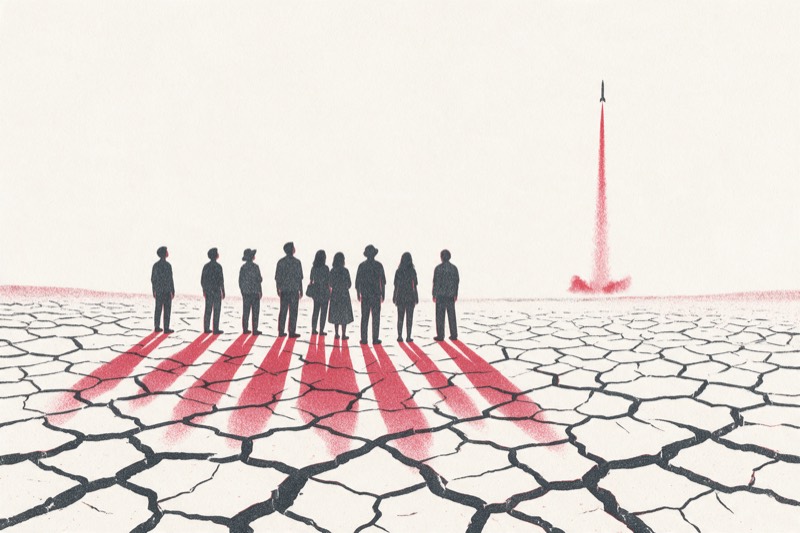
Our age has a paradoxical relationship with science: a selective faith. Never have we expected so much of it, and never have we listened to it so little. Whatever it establishes that constrains us, we demote to the rank of opinion.
Yet this sorting is only a symptom. Technology is not neutral: the criteria by which we develop it reflect the priorities of the economic and social system that funds it. When those priorities are no longer genuinely debated, the optimization of means ends up replacing our collective choices, down to the way we relate to care, to work and to democratic debate.
We Know, and We Do Not Believe What We Know
The Meadows report, The Limits to Growth, dates from 1972. For fifty years its authors were reproached for announcing an end of the world that never came. In the Journal of Industrial Ecology (2021), the researcher Gaya Herrington compared the real data observed up to 2019 with the model’s various scenarios. The trajectories that best match the observations foresee a halt in the growth of well-being around 2030, followed by a decline. The only scenario that avoids it (a deliberate stabilization begun in the early 2000s) is precisely the one we have strayed from the most. Other studies dispute this ranking, but the debate is more about the trajectory and the timing than about the existence of physical constraints.
So we do not lack information. The problem lies elsewhere, and it is more troubling: we know, and we do not believe what we know. In The Obsolescence of the Human (1956), the German philosopher Günther Anders gave this fault line a name, the “Promethean gap”: the distance between what we are able to produce and what we are able to imagine. What exceeds the imagination, he explains, never becomes entirely real. Knowledge then remains at the stage of data and never becomes conviction. The result is a lasting incoherence between what science establishes and what we decide.
Nowhere to Decide
At the heart of this process of decision lies the political, understood as a society’s capacity to deliberate about its ends. In 1996, Cornelius Castoriadis described “the rising tide of insignificancy,” the moment when public life keeps up its agitation without committing to anything essential. Thirty years later, the diagnosis has not aged.
Permitted debate unfolds inside a perimeter that the economic system has drawn for itself. It is a closed circuit. Even the left too often settles for a fiscal answer: tax more and redistribute better. The intention is honorable, but it presupposes exactly what it claims to correct, since one must first produce in order to share. In other words, the left no longer challenges the capitalist system; it argues over how to divide what the system produces.
Once our ends escape deliberation, we fall back on the only arbiter left to us: optimization. This amounts to handing technology the task of settling what we refuse to decide.
We Believe in Science; We No Longer Believe It
Our age can, without the slightest embarrassment, expect technology to solve everything while dismissing the scientific work that establishes its limits.
An announced breakthrough in nuclear fusion, carbon capture or artificial intelligence is greeted as scientific news, often before it has even left the prototype stage. By contrast, research establishing the depletion of a resource or the plateauing of a crop yield is treated as opinion. The first belongs to science, the second to activism. Yet both come out of the same laboratories and go through the same journals and the same peer review. The only thing that distinguishes them is that one sells a promise and the other announces a constraint.
To believe in science is to hope for miracles from it. To believe science is to accept its conclusions even when they are unwelcome. We do the first and refuse the second.
This amputation is an ideological choice. Nothing in the experimental method requires us to optimize yield rather than lifespan, power rather than repairability, or throughput rather than sobriety. These are criteria, and criteria are chosen. We gradually came to equate progress with an increase in available power without that choice ever being debated. We then deemed rational the work that serves it, and relegated the rest to the rank of opinion.
We still have to agree on what is rational. Techno-solutionism claims the mantle of reason and files those who doubt it under the irrational. It assumes that a rescue technology will exist, that it will work on a planetary scale, that it will arrive in time, that it can be financed, that the necessary materials will remain available, and that it will not produce effects worse than the ill it treats. If a single one of these conditions fails, the equation no longer holds. And none of them is assured today. Moreover, the consequences of an error would be irreversible. It is indeed an unreasonable wager, since it stakes what we cannot afford to lose.
This has less to do with rationality than with hope, in the theological sense of the word. Jacques Ellul saw it as early as 1973: by desacralizing nature, we did not put an end to the sacred; we transferred it onto technology. One need only listen to the great figures of Silicon Valley to see how right he was. They no longer speak only of investments and markets, but above all of duty, of consciousness to be preserved, of life insurance for the species. The vocabulary is that of salvation, and one no more debates salvation than one debates a faith.
What We Fund, What We Demote
This sorting applies not only to scientific results but to the disciplines themselves. The choice of funding priorities is not neutral. Public and private effort tends to favor the fields likely to increase our technical capacities directly: artificial intelligence, robotics, quantum computing, biotechnology. As these sectors become strategic, the disciplines that question their uses and purposes occupy an ever more secondary place in research. Because we no longer deliberate about our ends, we fund what produces means and demote what questions their use. We thus maximize what increases our power and minimize what would allow us to decide what to do with it.
The Price of Optimization
In essays such as “The Body and the Earth” and “Health Is Membership,” the Kentucky essayist and farmer Wendell Berry shows what this dynamic costs us in health. We have reduced the word to the absence of disease, yet, as Berry reminds us, “health” comes from the same root as “heal,” “whole” and “holy”: “To be healthy is literally to be whole; to heal is to make whole.” A doctor who takes no interest in food, in soil and in the state of the mind thus seems to him as absurd as a farmer indifferent to health. To treat the body as an isolated part is to collaborate in its destruction. The fragmentary approach cannot heal us, since it is itself the disease. We understand these interdependencies better than ever, and yet our social models make them impossible to honor in practice. We know, and the framework forbids us to take it into account. The result is a medicine remarkably competent at treating effects and often powerless before what produces them. We treat diabetes without touching the food system that manufactures it; we treat burnout without changing the organization of work that causes it; we medicalize loneliness without asking why a society produces so many people alone. Each specialty is beyond reproach within its own perimeter. The perimeter is precisely the problem, and no specialty has a mandate to step outside it. For Berry, “Conviviality is healing.”
Nancy Fraser gave this observation an economic formulation in Cannibal Capitalism (2022). What she calls the crisis of care is not a passing malfunction that better public policy could correct, but a structural contradiction. Capitalism rests on a foundation of activities it does not pay for (raising children, caring for relatives, sustaining households and bonds) and treats them as if they were free. It depends on them entirely, and its cult of endless accumulation methodically exhausts them. Fraser therefore speaks of cannibalism to describe a system that devours what it feeds on. In this context, medicine inherits an impossible task. It is asked to repair what the organization of work destroys, and to do so at the lowest possible cost.
Innovating Differently
It remains to show that we could do things differently, and this is where the charge of obscurantism collapses. Philippe Bihouix, an engineer trained at the École Centrale and a specialist in mineral resources, devoted The Age of Low Tech (2014; English translation 2020) to this demonstration. He does not plead for less technology, but for technology designed according to other criteria: questioning needs, producing goods that truly last, directing knowledge toward saving resources, seeking a balance between performance and conviviality, relocating production without losing the benefits of scale, and knowing how to remain modest.
Bihouix does not ask us to stop searching; he proposes that we search for something else. Designing a device that can be repaired for twenty years is a harder engineering problem than designing a disposable one. Restoring crop yields without synthetic nitrogen calls for more agronomy, not less. Low tech is not the opposite of science. It is a demanding application of science to different ends. The renunciation, if there is one, is not intellectual but commercial.
It is often objected that these techniques would not scale, and that one could not care for eight billion people with simple devices. That is true, and it is why Bihouix does not propose to generalize the rudimentary but to rank our uses, reserving high technology for what truly justifies it and lightening the rest. Note in passing that the argument is easily turned around. It is the current model that does not scale, since it would take several planets to extend it to the rest of the world.
What is at stake, then, is not progress but the confiscation of the word by just one of its possible definitions.
This confiscation does more than exhaust the resources of our physical world. It attacks our social usefulness with the same mechanical rigor. The logic of blind optimization, having already badly degraded our habitat, now threatens to make us useless within it.
A Society of Laborers without Labor
In 1958, Hannah Arendt opened The Human Condition with a hypothesis she considered formidable: “the prospect of a society of laborers without labor, that is, without the only activity left to them.” She distinguished three activities we have grown used to confusing. Labor, first, which answers biological necessity and is consumed in the cycle of producing and consuming. Work, next, which leaves durable objects behind and builds a common world. Action, finally, through which we appear before others and decide together. Modernity, she observed, has reduced all three to the first. We are no longer builders or citizens. We are laborers, which is to say consumers, since for her the two figures are one.
For a long time the hypothesis seemed hardly credible. It is no longer mere speculation. The labor economist Axelle Arquié founded the Observatoire des emplois menacés et émergents (Observatory of threatened and emerging jobs) to measure the phenomenon, breaking 923 occupations down into elementary tasks. The study conducted with Coface (in French) in the spring of 2026 finds that within two to five years, 16.3 percent of French jobs would be exposed (nearly five million positions), and that automation now targets a category of workers who until now thought themselves spared: engineers, developers, lawyers and financiers. This is technical exposure, not observed job losses, and the authors hold to that caution. The fact remains that we have a public, fine-grained map of the possible upheaval, and that the woman who drew it finds the political class failing to grasp its scale. We know, and we do not act.
We are routinely asked, “What do you do?” No one asks how we live, only what job we hold. Our place in production stands in for identity, and that place is itself measured by the volume of consumption it allows. A salary is not only for living: it ranks us, places us and says who we are. Pensions, social protection and social standing are indexed to it, and so is access to housing (since one must now borrow over twenty-three years to buy the home one bought over fifteen in 2000, as the previous essay showed).
We have thus built a large part of our identity on the one activity, of the three Arendt identified, whose centrality is now being called into question by automation. Automation strikes precisely where we have concentrated most of our social recognition: productive employment. Arendt’s paradox then becomes a practical question: how do we define ourselves in a world of work without work?
We have no answer, because we have spent two centuries unlearning the other ways of counting for our fellow human beings. A person whose worth rests essentially on a job that evaporates does not merely become poor. They become orphaned from their own existence. And we can better understand, then, why the subject is so carefully avoided: to touch it would force us to rebuild our idea of what a successful life is.
Who Are the Real Reactionaries?
To cast doubt on the idea of progress automatically places you among the reactionaries, the nostalgic, those who want to turn back the clock. Back to what, no one ever says. The association is so immediate that it spares anyone from examining the argument. Christopher Lasch, a man of the left, paid the price for it all his life, to the point of devoting The True and Only Heaven: Progress and Its Critics (1991) to dismantling the confusion. In his view, the critique of progress has historically come from popular and radical traditions, not from conservatives, who have always been quite comfortable with it.
The mechanism refutes nothing; it disqualifies the opponent, who then no longer needs to be read. We recognize here the gesture of every orthodoxy toward its heretics. It is the most economical way to dismiss those looking for a third way without ever having to debate them.
A conservative is someone who wants to keep things as they are. So who truly wants to keep things as they are? Those who propose to extend, untouched, a model whose limits science has been establishing for fifty years. A reactionary is someone who refuses movement. So who is refusing? Those for whom nothing fundamental must change, and who expect technology to spare them any decision. Nostalgic is the one who dreams of a vanished past. So what exactly do we dream of when we prophesy the return of growth? Of an energy configuration that lasted sixty years and lies behind us. Nostalgia is not where we think it is. It lies in the stubborn wait for the return of the Trente Glorieuses, France’s thirty-year postwar boom, and in the certainty that cheap oil was not a parenthesis but the natural state of the world.
The confiscation of the notion of progress does real damage, because progress implies a reasonable direction. But when it means nothing more than an extra helping of the same (faster, more efficient, more powerful), it ceases to be a direction and becomes an acceleration. And accelerating is not advancing when we do not know where we are going. It is exactly what a driver does who plunges into the fog without lifting his foot.
We are not asking to go backward, but to make democracy once again the place where our limits are decided. An earlier essay argued that, facing the wall of physical reality, maintaining our predatory metabolism would demand ever more social control and would carry us toward a totalitarian dynamic. Obscurantism today is the belief that technology will spare us this political choice. Permanent competition erodes the very conditions of collective decision, and with them any sense of the common good. Those who dodge this debate, handing out labels rather than discussing facts, are not defending the future. They are defending a model that has reached its own limits. It is time for obscurantism to change sides.