Essay IV · New
On the Necessity of Seeking Together
By Charles Peloye
Forthcoming in French in Antithèse · 11 min read
Translated from the French.
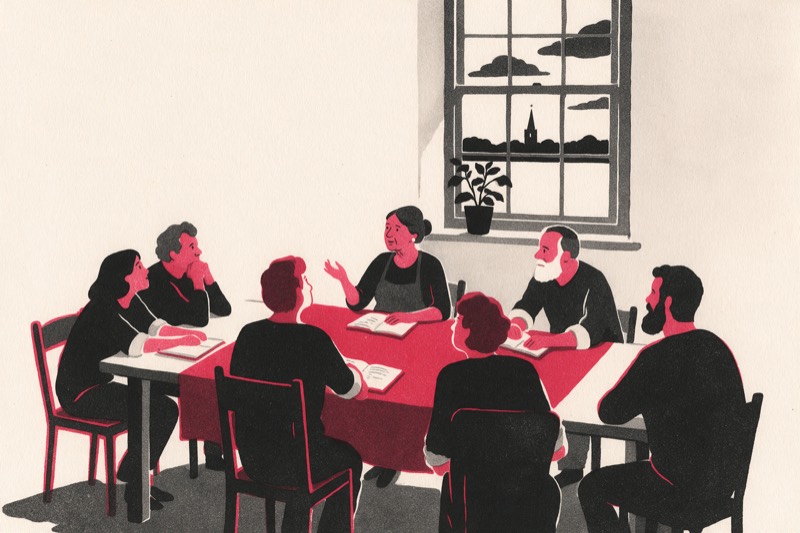
Many of us now notice how coarse and simplistic public debate has become. Nuance, once a virtue of the mind, has gradually vanished from much of public life. Its disappearance has been greatly helped along by the rise of opinion media and algorithms. It serves certain interests, but there is nothing inevitable about it.
Opinion Split in Two
Every day we experience the duality imposed on our opinions. On our phones, the binary approach prevails: like or don’t, share or ignore, answer a two-choice poll. On television, twenty-four-hour news channels often hold their audience by gathering a panel of commentators who agree with one another, confirming viewers in their positions. It is a pure expression of what the British psychologist Peter Wason identified in the 1960s as “confirmation bias.” Conversely, “cognitive dissonance” names the discomfort that contradiction can cause the human mind. Social networks play on both of these springs and favor whatever provokes a reaction, one way or the other, their first aim being to trigger an instinctive, even brutal, response. These systems are not designed to let anyone say “it depends,” “I don’t know” or “you may have a point there.”
This absence of nuance rests on well-documented psychological mechanisms. In a study published in PNAS in 2021, a Cambridge team analyzed more than 2.7 million Facebook and Twitter posts by American news outlets and elected officials. Each word referring to the opposing camp increased the odds that a post would be shared by 67 percent. The same year, in Science Advances, Yale researchers followed more than 7,000 Twitter users. Those whose outraged posts received the most likes went on to express more outrage. The like works as a reward, and each of us gradually learns what it brings. Public debate thus ends up taking the shape of the tools that carry it.
Simplification and polarization did not take hold by chance. They have their own history and serve very specific interests. Understanding how they settled in also gives us a glimpse of how to get out.
Bernays, or the Manufacture of Opinion
The thought of Edward Bernays (1891–1995) deserves a closer look in this regard. A nephew of Sigmund Freud, he is considered the father of public relations. With Propaganda, published in 1928, he became one of the first to theorize the application of crowd psychology and psychoanalysis to mass persuasion: “The minority has discovered a powerful help in influencing majorities. It has been found possible so to mold the mind of the masses that they will throw their newly gained strength in the desired direction. In the present structure of society, this practice is inevitable. […] Propaganda is the executive arm of the invisible government.”
During the First World War, Bernays worked for the Committee on Public Information, which President Wilson had charged with persuading Americans to support their country’s entry into the war. The campaign remained a model of its kind. Led by the journalist George Creel, the committee flooded the country with posters, pamphlets and films, and mobilized seventy-five thousand volunteer speakers, the “Four Minute Men,” to give short speeches in movie theaters. These messages carefully avoided the gruesome reality of the trenches. Instead they spoke of patriotic duty and of a crusade to make the world, in President Wilson’s phrase, “safe for democracy.” War loans, the Liberty Bonds, were sold to Americans both as a patriotic act and as a safe investment. Citizens were thus invited to take part in the war and to find their own interest in it, rather than to weigh its consequences. At the same time, dissent was repressed: in 1918 the socialist Eugene Debs was sentenced to ten years in prison for giving an antiwar speech in Canton, Ohio. Only two positions remained possible: support the war or be taken for a traitor. It was an early example of the art of creating dogmatic oppositions in a democracy. Creel would later recount the experience in a book with a telling title, How We Advertised America.
Bernays went on to put these new methods at the service of companies and politicians. In 1929, for the American Tobacco Company, he had young women parade through New York with cigarettes in hand, presented as “torches of freedom,” breaking the taboo that kept women from smoking in public and opening the market to a new clientele. In the early 1950s, for the United Fruit Company, he ran a campaign portraying the government of Guatemala as a communist threat, shortly before the CIA-backed coup of 1954.
We readily associate propaganda with totalitarian regimes, yet its modern methods were developed in a liberal democracy, that of the United States. Worse still, Bernays recounts in his memoirs that he learned in 1933 that Goebbels was using one of his books to orchestrate his campaign against the Jews of Germany. The word itself was already suspect by the end of the war. As early as 1920, Creel explained that his committee had avoided it because the Germans had associated it with deceit. It was when the term propaganda became disreputable that Bernays replaced it with public relations.
Emotion as Commodity
Bernays at least had the merit of candor. He even openly embraced methods that he would name, in 1947, “The Engineering of Consent.” Capitalism now frames almost the whole of our existence, and it has given persuasion means that no power in history ever had. In Bernays’s day, the mass press, radio and cinema could already spread an idea across a whole country in a few days. In the digital age, diffusion has become nearly instantaneous, and it reaches each of us individually.
Nearly a century after Propaganda, the sociologist Eva Illouz shows in Le futur des émotions (The future of emotions; Gallimard, 2026) that technological capitalism has taken up this project by other means. It is commonly thought that apps and algorithms distance us from our emotions. She argues the exact opposite: we are living through an unprecedented “emotionalization” of capitalism, in which our emotions, handed over for free, become a raw material, and therefore a commodity. To profit from them, platforms capture our attention, observe our reactions and work to influence them. Emotional engagement is thus produced, measured and turned into revenue. Hence the paradox of a society that overvalues emotions but in which people listen to one another less and less.
Not all emotions have the same value in this system. Outrage, fear and anger provoke faster and stronger reactions than careful reflection. The studies cited above show it: content that pits two camps head to head generates more comments, more shares, and therefore more time spent in front of the screen than a text that calls for dialogue. Nuance remains possible, but it pays less, and a system that seeks above all to maximize engagement ends up making it invisible.
This, however, deserves some nuance of its own. During the 2020 American presidential election, researchers ran several experiments with Meta on Facebook and Instagram, published in 2023. In Science, Andrew Guess’s team at Princeton showed that replacing the algorithm with a simple chronological feed for three months did not significantly change users’ political opinions or their degree of polarization. In Nature, Brendan Nyhan’s team reduced content from users’ own side by about a third for more than 23,000 users, with no measurable effect on their opinions. Platforms, then, do not directly manufacture our opinions. They do, however, decide what is visible, and they give the image of a society more divided than it is. Illouz goes so far as to evoke the risk of a break with reality, in which we react to representations of the real rather than to the real itself.
Unlike in Bernays’s day, this system no longer needs a manipulator. It works because everyone plays their part without feeling responsible for the whole.
The Dilution of Responsibility
How can such a system last without anyone trying to stop it? In the early 1960s, the American psychologist Stanley Milgram offered a troubling answer. He had designed his experiments to understand how ordinary men could have taken part in the Holocaust, the very year of Eichmann’s trial in Jerusalem. At Yale University, volunteers were recruited for a scientific study whose true purpose they did not know. Under the supervision of an experimenter in a gray lab coat, they were to give increasingly strong electric shocks to another participant each time he answered their questions wrongly. The shocks were fake and the victim was an actor, but the volunteers did not know it. In the best-known version of the experiment, nearly two-thirds of them went all the way to the maximum shock, despite the cries of pain the actor simulated, simply because a researcher asked them to continue.
In one variant, the volunteer merely read the questions while another participant operated the generator, and 37 out of 40 then went all the way. The more one is a mere link in the chain, the easier it is to go far.
Milgram called this phenomenon the agentic state. When people see themselves as the agent of an authority, they stop feeling responsible for their actions and focus only on carrying out well what is expected of them. He drew a disturbing conclusion: ordinary people, with no particular hostility, can become the cogs of a destructive enterprise. Sometimes a few changes in newspaper headlines, or an order from a superior, are enough to lead them to kill without much difficulty.
Henri Verneuil brought this experiment to the screen in 1979 in I as in Icarus, which transposes the assassination of John F. Kennedy and the investigation that followed to an imaginary country. In a famous scene, the prosecutor Volney, played by Yves Montand, concludes: “Which means that in a civilized, democratic and liberal country, two-thirds of the population are capable of carrying out any order coming from a higher authority.” Professor Naggara, played by Roger Planchon, soberly adds: “At every link in the chain, obedience has been made comfortable.”
Public debate today works by a comparable logic, except that authority no longer has a face and the links have multiplied. The journalist picks the headline that will draw the most clicks, the politician looks for the sentence that will be repeated, the platform promotes whatever holds attention, the advertiser pays for that attention, and each of us shares what outrages us. Each obeys the metric that concerns them and can tell themselves they are only doing their job. No one decided that debate would be reduced to for or against, and yet everyone contributes to it. Here we find again the logic of optimization discussed in an earlier essay, in which a metric, here engagement, ends up standing in for judgment.
Attention as Generosity
In this context, nuance has a bad reputation. It is readily mistaken for lukewarmness, hesitation or a lack of courage. Yet to be nuanced is to accept that the other person may be right on a given point, to take the time to understand what they are really saying before answering, and to recognize that reality rarely lets itself be confined to two opposing positions.
It takes effort. In 1957, the American psychologist Leon Festinger formulated the concept of “cognitive dissonance” mentioned above. He showed that we instinctively try to end the discomfort that contradiction causes, often by discrediting the troubling information rather than revising our judgment. We should instead welcome that discomfort as a sign that the other person may have something to teach us.
In 1942, in a letter to the poet Joë Bousquet, the philosopher Simone Weil wrote: “Attention is the rarest and purest form of generosity.” The sentence takes on a particular resonance today. Our attention has become a resource that is captured, measured and resold, whereas Weil described it as a gift we give to someone. To truly listen to the person in front of us, and to consider what they say rather than look for the argument that will silence them, is to do exactly what the system described above makes difficult.
Nuance, then, is less a technique of argument than a form of respect. It means seeing in someone who does not think as we do a legitimate interlocutor rather than an adversary, and that is no doubt what makes it so rare today.
It also calls for empathy, and for sincere consideration of the other person’s feelings, even when we do not share them. This does not mean that all ideas are equal. The moral framework of a balanced society is precisely the fruit of its exchanges and its collective deliberations. The moral and intellectual rigor that nuance demands may seem out of reach, but we must humbly accept that we will sometimes fall short of it, and that this is part of our humanity.
Recovering the Political
It remains to be seen how to bring this attention back into collective debate. Bruno Latour suggested one way, which he recounts in Conversation avec Bruno Latour (Conversation with Bruno Latour), a book of interviews with Éric Fottorino and François Vey published by Autrement in 2024. He returns there to an experiment inspired by the cahiers de doléances of 1789. On the eve of the Revolution, the French had been invited to set down their hardships and their hopes in registers of grievances before the country’s future was debated. Latour revived this gesture with groups of local residents, asking them to describe their daily lives and what they concretely depend on, rather than to defend their ideas.
In his view, this means turning away from politics as it is practiced today: “Recovering the political takes time. And paradoxically, for that very reason, we have to counter political discussion, because this form of expression has now run its course. If we are not careful, we end up in a kind of indignation, with insults or demands addressed to a State that is not real.”
The value of this approach is that it produces nuance without having to demand it. When each person describes their actual situation, their work, their housing, their commute, what they could not do without, entrenched positions lose their force. It becomes hard to reduce a life to a camp. We discover common interests where we saw only oppositions, and precise disagreements where we saw only blocs.
Perhaps this is where the answer lies to the logic described by Bernays and by Illouz. Everything pushes us to react to opinions, images and slogans. Nuance does not mean giving up disagreement; it means refusing to let disagreement excuse us from understanding. To return to the real, to take the time to describe it and to grant others the attention Simone Weil spoke of is to step out of this game. On that condition, debate can become what it should always be: a way of seeking together.